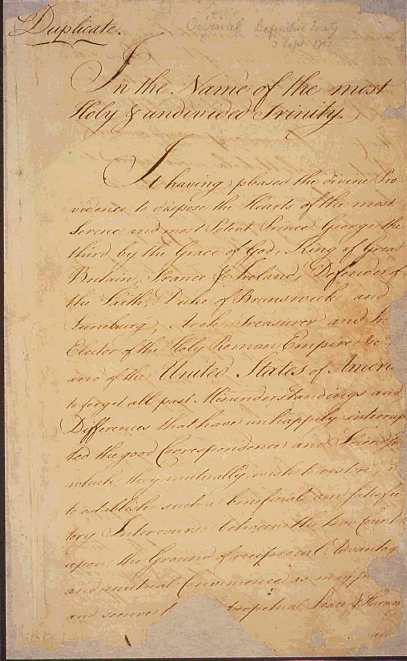
1783 Treaty of Paris

September 3rd, 1783
Image Courtesy of: National Archives and Records Administration
The Treaty of Paris, signed by Commissioners Benjamin Franklin, John Adams, John Jay and John Hartley on September 3, 1783, effectively ended the American Revolutionary War between Great Britain on one side and the United States of America and its allies on the other. The other combatant nations, France, Spain and the Dutch Republic had separate treaty agreements. The territorial provisions to the United States were "exceedingly generous."
A year and half later, in his rooms at the Hotel
de York and agreed to end the war with "The Definitive
Treaty of Peace between his Britannic Majesty and the United States of
America." The Treaty was immediately dispatched to United States
Congress Assembled President Elias Boudinot and King George III as Article
Ten required
“The solemn ratifications of the present treaty expedited in
good and due form shall be exchanged between the contracting parties in the
space of six months or sooner, if possible, to be computed from the day of the
signatures of the present treaty.”
Table that served for the signing of the Treaty of Paris which, formally established American Independence from Great Britain.

Students and Teachers of US History this is a video of Stanley and Christopher Klos presenting America's Four United Republics Curriculum at the University of Pennsylvania's Wharton School. The December 2015 video was an impromptu capture by a member of the audience of Penn students, professors and guests that numbered about 200. - Click Here for more information
Brief Background:
In March 1782, shortly
after the fall of Lord North's ministry, Peace Commissioner Benjamin Franklin
sent a letter seeking a “general peace”
to Lord Shelburne.
Lord Cholmondeley
having kindly offered to take a letter from me to your Lordship, I embrace the
opportunity of assuring the continuance of my ancient respect for your talents
and virtues, and of congratulating you on the returning good disposition of
your country in favour of America, which appears in the late resolutions of the
Commons. I am persuaded it will have good effects. I hope it will tend to
produce a general peace, which I am sure your Lordship with all good men
desires, which I wish to see before I die, and to which I shall with infinite
pleasure contribute everything in my power.
By the time the letter
reached London, the new ministry, in which Shelburne was then Secretary of
State for home and colonies, had already been formed. Secretary Shelburne, with
the approval of the cabinet, replied by dispatching to Paris an agent to talk
with Franklin informally to determine the terms upon which the Americans would
make peace. The person chosen for this purpose was Richard Oswald, a Scottish
merchant of frank disposition and open-minded views.
In April there were
several conversations between Oswald and Franklin. The most noteworthy
point Franklin made was that in order to make a durable peace the nations must
remove all occasions for future quarrel. The line of frontier between New
York and Canada was populated by a lawless set of men, who in time of peace
would be likely to breed trouble between their respective governments. Franklin
articulated that it would be wise for England to cede Canada to the United
States. A similar reasoning was also used for Nova Scotia in their initial
meetings. Franklin furthered reasoned that by ceding these lands to the United
States, it would be possible from their sale, to indemnify the Americans for
all losses of private property during the war, and also to make reparation to
the Tories whose estates had been confiscated. By pursuing such a policy,
England, which had made war on America unjustly, and had wantonly done it great
injuries, would achieve not merely peace, but reconciliation with America, and
reconciliation, said Franklin, is "a sweet word."
This was an
exceptionally bold tone for Franklin to take but he knew that almost every
member of the Whig ministry had publicly articulated the opinion that the war
against America was unjust and wanton. Benjamin Franklin who was a shrewd
hand at a bargain masterfully set his terms sky high. Oswald, surprisingly,
seemed to have been convinced by Franklin's reasoning, and expressed neither
surprise nor reluctance at the idea of ceding Canada. The main points of this
meeting were noted upon a sheet of paper, which Franklin permitted Oswald to
take to London and show to Lord Shelburne, first writing upon it an
express “declaration” of its informal character.
On receiving this
memorandum, Shelburne did not show it to the cabinet, but returned it to
Franklin without any immediate answer, after keeping it only one night. Oswald
was presently sent back to Paris empowered as commissioner to negotiate with
Franklin. Oswald carried Shelburne's answer to the memorandum that
desired the cession of Canada addressing Franklin’s three main points. The
message was terse:
1. By way of reparation. -- Answer: No reparation can
be heard of.
2. To prevent future wars. -- Answer: It is to be hoped that some more friendly method will be found.
2. To prevent future wars. -- Answer: It is to be hoped that some more friendly method will be found.
3. As a fund of indemnification to loyalists. -- Answer: No
independence to be acknowledged without their being taken care of.
Shelburne added that “the
Americans would be expected to make some compensation for the surrender of
Charleston, Savannah, and the City of New York, still held by British
troops.”
From this it appears
that Shelburne, as well as Franklin, knew how to begin by asking more than he
was likely to get. England was no more likely to listen to a proposal for
ceding Canada than the Americans were to listen to the suggestion of
compensating the British for surrendering New York. But there can be little
doubt that the bold stand thus taken by Franklin at the outset, together with
the influence he exerted over Oswald, contributed materially to the dazzling
success of the American negotiations.
With the formal
appointment of a British Commissioner the negotiations of the initiative passed
almost entirely out of Benjamin Franklin’s hands as his colleagues, John Jay
and John Adams took over the talks with Great Britain. The form that the treaty
took was mainly the work of Jay and Adams. The services of Franklin were
chiefly valuable at the beginning, and again, to some extent, at the end.
U.S. Peace Commissioner John Jay, a former President of the U.S. Continental Congress, refused to continue treaty negotiations with Great Britain unless the United States was recognized as a
foreign nation. Additionally Jay,
against the direct orders of the United States in Congress Assembled, persuaded fellow
Commissioners John Adams and Benjamin Franklin to exclude France from the treaty negotiations. Jay was quick to note that France was quite hostile to their North American land claims.
France sought to see the United States territorial claims between the Alleghenies and the Mississippi to be divided between England and Spain. France had hoped that England would have the lands north of the Ohio, and the region south of it to remain an Indian territory under the protectorate of Spain. The French were willing to concede a narrow strip on the western slope of the Alleghenies, over which the United States would be permitted to "excise protectorship." In other words, France wished to confine the United States to the east of the Alleghenies and prevent their expansion westward into what would be later known as the Louisiana Purchase. France also sought to exclude the United States from all share in the fisheries, in order to prevent the new nation from becoming a great naval power. France was an ally only up to a certain point and this antagonism of interests made joint negotiations extremely difficult.
The three Commissioners, at Jay's bidding, unanimously required the British Ministry to formulate a new
commission authorizing Peace Commissioner Richard Oswald to negotiate a treaty without France or Spain and with the United States of America as a sovereign nation. The absence of France and Spain in the
negotiations came as a great relief to Great Britain because it took their
claims to North American territory off the negotiation table in the area being
claimed by the United States of America. On September 21st, 1782,
Parliament passed an act empowering Commissioner Oswald to enact a treaty with
United States of America as a sovereign nation:
An act to enable his Majesty to conclude a peace or truce with certain colonies in North America therein mentioned, it is recited … And it is our royal will and pleasure, and we do hereby authorize, empower and require you, the said Richard Oswald, to treat, consult of, and conclude with any commissioners or persons veiled with equal powers, by, and on the part of the Thirteen United States of America, viz. New Hampshire, Massachusetts Bay, Rhode Island, Connecticut, New York, New Jersey, Pennsylvania, the three Lower Counties on Delaware, Maryland, Virginia, North Carolina, South Carolina, and Georgia, in North America, a peace or a truce with the said Thirteen United States, any law, act or acts of parliament, matter or thing, to the contrary in any wise notwithstanding.[1]
The date of September 21st,
1782, unbeknownst to most U.S. citizens not September 3rd, 1783, marks Great Britain’s recognition of United States’
sovereignty. Commissioner John Jay wrote to Foreign Secretary Robert R. Livingston:
Dear Sir, I have only time to inform you that our objections to Mr. Oswald's first commission have produced a second, which arrived yesterday. It empowers him to treat with the Commissioners of the Thirteen United States of America. I am preparing a longer letter on this subject, but as this intelligence is interesting, I take the earliest opportunity of communicating it.[2]
On October 5th, 1782, with
the “colonies” now recognized by Great Britain as “more or less” United States, John Jay turned over their treaty plan to Oswald. The plan included the new clauses relating to
independence, the territorial boundaries and the articles on the fisheries.
Oswald, in enclosing the plan to his government, wrote: "I look upon
the treaty as now closed."


On November 17th Jay
wrote U.S. Foreign Secretary Livingston a long letter outlining his progress in
the Treaty of Paris negotiation from his arrival stating:
Although it is uncertain when I shall have an opportunity either
of finishing or transmitting the long, particular letter which I am now
undertaking to write, I think the matter it will contain is too interesting to
rest only in my memory, or in short notes, which nobody but myself can well
unfold the meaning of. I shall, therefore, write on as my health will permit,
and when finished shall convey this letter by the first prudent American that
may go from hence to Nantes or L'Orient. My reception here was as friendly as
an American minister might expect from this polite and politic court; for I
think they deceive themselves who suppose that these kind of attentions are
equally paid to their private as to their public characters. [105]
 |
| Treaty with United Kingdom Preliminary Articles of Peace, November 30th, 1782. - Peace was desired by all parties as the Revolutionary War waged on. However the decisive battle at Yorktown on October 19, 1781 was a turning point and peace negotiations became formalized. Once Great Britain agreed to acknowledge the United States as free, sovereign, and an independent state, sensitive issues on boundaries, fishing rights, and compensation still needed resolution. Neither side got all that it wanted, and the language was at times purposely vague. However, on November 30, 1782, a preliminary treaty of peace was reached. -- General Records of the United States Government, National Archives |
Jay’s account was
precise and concluded with an account from the time Mr. Oswald received a
suitable Commission to negotiate a viable Treaty and his reasons for excluding
France from the negotiations:
On the 27th of September, Mr. Vaughan returned here from England,
with the courier that brought Mr. Oswald's new commission, and very happy were
we to see it. Copies of it have already been sent to you, so that I will not
lengthen this letter by inserting it here; nor will I add anything further on
this head at present, than to assure you that Mr. Vaughan greatly merits our
acknowledgments.
The next thing to be done was to prepare and draw up the proposed
articles. They were soon completed and settled between us and Mr. Oswald, by
whom they were sent to his court, with letters declaring his opinion that they
ought to be accepted and agreed to; but they differed with him in opinion.
These articles, for very obvious reasons, were not communicated to
the Count de Vergennes.
Mr. Oswald did not receive any opinion from his court relating to
our articles until the 23d of October, when letters from the minister informed
him that the extent of our boundaries, and the situation of the Tories,
&c., caused some objections, and the minister's secretary was on the way
here to confer with us on those subjects.
On the 24th of October, I dined at Pussy with Dr. Franklin, where
I found M. Rayneval. After dinner we were in private with him a considerable
time. He desired to know the state of our negociation with Mr. Oswald. We told
him that difficulties had arisen about our boundaries, and that one of the minister's
secretaries was coming here with papers and documents on that subject. He asked
us what boundaries we claimed. We told him the river St. John to the east, and
ancient Canada, as described in the proclamation, to the north. He contested
our right to such an extent to the north, and entered into several arguments to
show our claim to be ill founded. These arguments were chiefly drawn from the
ancient French claims, and from a clause in the proclamation restraining
governors from making grants in the Indian country, &c.
He inquired what we demanded as to the fisheries. We answered that
we insisted on enjoying a right in common to them with Great Britain. He
intimated that our views should not extend further than a coast fishery, and
insinuated that pains had lately been taken in the eastern States to excite
their apprehensions, and increase their demands on that head. We told him that
such a right was essential to us, and thug our people would not be content to
make peace without it; and Dr. Franklin explained very fully their great
importance to the eastern States in particular. He then softened his manner,
and observed that it was natural for France to wish better to us than to
England; but as the fisheries were a great nursery for seamen, we might suppose
that England would be disinclined to admit others to share in it, and that for
his part he wished there might be as few obstacles to a peace as possible. He
reminded us, also, that Mr. Oswald's new commission had been issued posterior
to his arrival at London.
On the 26th of October Mr. Adams arrived here, and in him I have
found a very able and agreeable coadjutor ... I am sensible of the impression
which this letter will make upon you and upon Congress, and how it will affect
the confidence they have in this court. These are critical times, and great
necessity there is for prudence and secrecy.
So far, and in such matters as this court may think it their
interest to support us, they certainly will, but no further, in my opinion.
They [France]are interested in separating us from Great Britain,
and on that point we may, I believe, depend upon them; but it is not their
interest that we should become a great and formidable people, and therefore
they will not help us to become so. It is not their interest that such a treaty
should be formed between us and Britain as would produce cordiality and mutual
confidence. They will therefore endeavor to plant such seeds of jealousy,
discontent, and discord in it as may naturally and perpetually keep our eyes fixed
on France for security. This consideration must induce them to wish to render
Britain formidable in our neighborhood, and to leave us as few resources of
wealth and power as possible.
It is their interest to keep some point or other in contest
between us and Britain to the end of the war, to prevent the possibility of our
sooner agreeing, and thereby keep us employed in the war, and dependent on them
for supplies. Hence they have favored and will continue to favor the British
demands as to matters of boundary and the Tories.
The same views will render them desirous to continue the war in
our country as long as possible, nor do I believe they will take any measures
for our repossession of New York unless the certainty of its evacuation should
render such an attempt advisable. The Count de Vergennes lately said that there
could be no great use in expeditions to take places which must be given up to
us at a peace.
Such being our situation, it appears to me advisable to keep up
our army to the end of the war, even if the enemy should evacuate our country;
nor does it appear to me prudent to listen to any overtures for carrying a part
of it to the West Indies in case of such an event.
I think we have no rational dependence except on God and
ourselves, nor can I yet be persuaded that Great Britain has either wisdom,
virtue, or magnanimity enough to adopt a perfect and liberal system of
conciliation. If they again thought they could conquer us, they would again
attempt it.
We are nevertheless, thank God, in a better situation than we have
been. As our independence is acknowledged by Britain, every obstacle to our
forming treaties with neutral powers and receiving their merchant ships is at
an end, so that we may carry on the war with greater advantage than before in
case our negociations for peace should be fruitless.
It is not my meaning, and therefore I hope I shall not be
understood to mean, that we should deviate in the least from our treaty with
France; our honor and our interest are concerned in inviolably adhering to it.
I mean only to say that if we lean on her love of liberty, her affection for
America, or her disinterested magnanimity, we shall lean on a broken reed, that
will sooner or later pierce our hands, and Geneva as well as Corsica justifies
this observation.
I have written many disagreeable things in this letter, but I
thought it my duty. I have also deviated from my instructions, which, though
not to be justified, will, I hope, be excused on account of the singular and
unforeseen circumstances which occasioned it.
Let me again recommend secrecy. [106]
Jay spoke of their
perfect accord as a team acknowledging Mr. Adams's services on the eastern
boundaries and Franklin's contributions on the subject of the Tories.
John Adams wrote in his Diary of Jay’s
resolve in the negotiations:
That J. insists on having an exchange of full Powers, before he
enters on Conference or Treaty. Refuses to treat with D'Aranda, until he has a
Copy of his Full Powers. Refused to treat with Oswald, until he had a
Commission to treat with the Commissioners of the United States of America. --
F. was afraid to insist upon it. Was afraid We should be obliged to treat
without. Differed with J. Refused to sign a Letter &c. Vergennes wanted him
to treat with D'Aranda, without. [107]
Adams also went on to
record John Jay’s jaded feelings about the French and their role in the
negotiations recording in his diary on November 5, 1782:
Mr. Jay likes Frenchmen as little as Mr. Lee and Mr. Izard did. He
says they are not a Moral People. They know not what it is. He don’t like any
Frenchman. -- The Marquis de la Fayette is clever, but he is a Frenchman. --
Our Allies don’t play fair, he told me. They were endeavouring to deprive us of
the Fishery, the Western Lands, and the Navigation of the Missisippi. They
would even bargain with the English to deprive us of them. They want to play
the Western Lands, Mississippi and whole Gulf of Mexico into the Hands of
Spain. [108]
Adams wrote Abigail on
November 8 of the Peace Commissioner’s success:
The King of Great Britain, by a Commission under the great Seal of
his Kingdom, has constituted Richard Oswald Esqr. his Commissioner to treat
with the Ministers Plenipotentiary of the United States of America, and has
given him full Powers which have been mutually exchanged. Thus G.B. has Shifted
Suddenly about, and from persecuting us with unrelenting Bowells, has
unconditionally and unequivocally acknowledged Us a Sovereign State and
independent Nation. It is surprising that she should be the third Power to make
this Acknowledgment. She has been negotiated into it, for Jay and I
peremptorily refused to Speak or hear, before We were put upon an equal Foot.
Franklin as usual would have taken the Advice of the C. [Comte] de V.
[Vergennes] and treated, without, but nobody would join him. [109]
Finally Adams wrote
Foreign Secretary Livingston this
November 21st letter concerning the negotiations:
We live in critical moments. Parliament is to meet, and the King's
speech will be delivered on the 26th. If the speech announces Mr. Oswald's
commission, and the two houses, in their answers, thank him for issuing it, and
there should be no change in the ministry, the prospect of peace will be
flattering. Or, if there should be a change in the ministry, and the Duke of
Portland, with Mr. Fox and Mr. Burke, should come in, it will be still more so.
But if Richmond, Camden, Keppel, and Townshend should retire, and my Lord North
and company come in, with or without the Earl of Shelburne, the appearances of
peace will be very unpromising. My Lord North, indeed, cannot revoke the
acknowledgment of our independence, and would not probably renounce the
negotiations for peace, but ill-will to us is so habitual to him and his
master, that he would fall in earnestly with the wing-clipping system; join in
attempts to deprive us of the fisheries and the Mississippi, and to fasten upon
us the Tories, and in every other measure to cramp, stint, impoverish, and
enfeeble us. Shelburne is not so orthodox as he should be, but North is a much
greater heretic in American politics.
It deserves much consideration what course we should take in case
the old ministry should come in whole or in part. It is certain, at present,
that to be obnoxious to the Americans and their ministers is a very formidable
popular cry against any minister or candidate for the ministry in England, for
the nation is more generally for recovering the good-will of the Americans than
they ever have been. Nothing would strike such a blow to any ministry as to
break off the negotiations for peace; if the old ministry come in, they will
demand terms of us at first, probably, that we can never agree to.
It is now eleven or twelve days since the last result of our
conferences were laid before the ministry in London. Mr. Vaughan went off on
Sunday noon, the 17th, so that he is no doubt before this time with my Lord
Shelburne. He is possessed of an ample budget of arguments to convince his
lordship that he ought to give up all the remaining points between us. Mr.
Oswald's letters will suggest the same arguments in a different light, and Mr.
Strachey, if he is disposed to do it, is able to enlarge upon them all in conversation.
The fundamental point of the sovereignty of the United States
being settled in England, the only question now is, whether they shall pursue a
contracted or a liberal, a good-natured or an ill-natured plan towards us. If
they are generous, and allow us all we ask, it will be the better for them; if
stingy, the worst. That France don't wish them to be very noble to us may be
true. But we should be dupes, indeed, if we did not make use of every argument
with them to show them that it is their interest to be so, and they will be the
greatest bubbles of all if they should suffer themselves to be derived by their
passions, or by any arts, to adopt an opposite tenor of conduct.[110]


John Jay was especially
concerned over the fate of the Tories in the negotiations, especially New York
as the British had held the city for six long years. There was much
dissent among N.Y. patriots over the loyalist who prospered in the city during
the revolution. The New York Governor just after he was elected:
… persecuted, robbed, plundered, banished, and imprisoned, the
unhappy loyalists at a great rate. His inveteracy, his rancor, and hatred to
Great Britain and the Loyalists, he carried so far, that he has been heard to
say, ‘that he had rather roast in hell to all eternity, than‘ consent to a
dependence upon Great Britain, or ‘show mercy to a damned Tory.’ [111]
On Monday, November 25th the
Commissioners heard from Stratchey and Oswald. Adams recorded in his
diary:
Dr. F., Mr. J. and myself at 11 met at Mr. Oswalds Lodgings. Mr.
Stratchey told Us, he had been to London and waited personally on every one of
the Kings Cabinet Council, and had communicated the last Propositions to them.
They every one of them, unanimously condemned that respecting the Tories, so
that that unhappy Affair stuck as he foresaw and foretold that it would.
The Affair of the Fishery too was somewhat altered. They could not
admit Us to dry, on the Shores of Nova Scotia, nor to fish within three Leagues
of the Coast, nor within fifteen Leagues of the Coast of Cape Breton.
The Boundary they did not approve. They thought it too extended,
too vast a Country, but they would not make a difficulty.
That if these Terms were not admitted, the whole Affair must be
thrown into Parliament, where every Man would be for insisting on Restitution,
to the Refugees.
He talked about excepting a few by Name of the most obnoxious of
the Refugees.[112]
In his diary, Adams
continues recording the proposed changes to the treaty with surprising details
and concludes that day’s business writing:
Mr. Jay desired to know, whether Mr. Oswald had now Power to
conclude and sign with Us? Stratchey said he had absolutely. Mr. Jay desired to
know if the Propositions now delivered Us were their Ultimatum. Stratchey
seemed loth to answer, but at last said No. -- We agreed these were good Signs
of Sincerity.[113]
Commissioner
Henry Laurens, who was released from
the Tower of London in a prisoner exchange for General Cornwallis, arrived in
Paris in late November 1782. Adams wrote of his participation in the
negotiations of the Preliminary Treaty:
November 29, 1782 -- Met Mr. Fitzherbert, Mr.
Oswald, Mr. Franklin, Mr. Jay, Mr. Laurens, and Mr. Strachey, at Mr. Jay's,
Hôtel d'Orléans, and spent the whole day in discussions about the fishery and
the Tories.
Commissioner Oswald produced a paper from his
pocket, in which he had drawn up a claim, and he said the first principle of
the treaty was equality and reciprocity. Now, they demanded of us payment of
debts, and restitution, or compensation to the refugees.
Upon this, I recounted the history of General
Gage's agreement with the inhabitants of Boston, that they should remove with
their effects, upon condition that they would surrender their arms; but as soon
as the arms were secured, the goods were forbid to be carried out, and were
finally carried off in large quantities to Halifax. Dr. Franklin mentioned the
case of Philadelphia, and the carrying off of effects there, even his own
library. Mr. Jay mentioned several other things, and Mr. Laurens added the plunders
in Carolina, of negroes, plate, &c.
I said I never could put my hand to any
articles without satisfaction about the fishery; that Congress had, three or
four years ago, when they did me the honor to give me a commission to make a
treaty of commerce with Great Britain, given me a positive instruction not to
make any such treaty without an article in the treaty of peace acknowledging
our right to the fishery; that I was happy Mr. Laurens was now present, who, I
believed, was in Congress at the time and must remember it. Mr. Laurens upon
this said, with great firmness, that he was in the same case and could never
give his voice for any articles without this. Mr. Jay spoke up, and said it
could not be a peace; it would only be an insidious truce without it.
November 30, 1782. - We met first at Mr. Jay's,
then at Mr. Oswald's; examined and compared the treaties. Mr. Strachey had left
out the limitation of time, the twelve months, that the refugees were allowed
to reside in America, in order to recover their estates, if they could. Dr.
Franklin said this was a surprise upon us. Mr. Jay said so too. We never had
consented to leave it out, and they insisted upon putting it in, which was
done.
Mr. Laurens said there ought to be a stipulation
that the British troops should carry off no negroes or other American property.
We all agreed. Mr. Oswald consented. Then the treaties were signed, sealed, and
delivered, and we all went out to Passy to dine with Dr. Franklin. Thus far has
proceeded this great affair. The unravelling of the plot has been to me the
most affecting and astonishing part of the whole piece.
I was very happy that Mr. Laurens came in,
although it was the last day of the conferences, and wish he could have been
sooner. His prehension, notwithstanding his deplorable affliction under the
recent loss of so excellent a son, is as quick, his judgment as sound, and his
heart as firm as ever. He had an opportunity of examining the whole, and
judging and approving; and the article which he caused to be inserted at the
very last, that no property should be carried off--which would most probably,
in the multiplicity and hurry of affairs, have escaped us--was worth a longer
journey, if that had been all. But his name and weight is added, which is of much
greater consequence.[76]
On November 30, 1782
Adams recorded:
NOVEMBER 30 SATURDAY. ST. ANDREWS DAY: We met first at Mr.
Jays, then at Mr. Oswalds, examined and compared the Treaties. Mr. Stratchey
had left out the limitation of Time, the 12 Months, that the Refugees were
allowed to reside in America, in order to recover their Estates if they could.
Dr. Franklin said this was a Surprize upon Us. Mr. Jay said so too. We never
had consented to leave it out, and they insisted upon putting it in, which was
done. Mr. Laurens said there
ought to be a Stipulation that the British Troops should carry off no Negroes
or other American Property. We all agreed. Mr. Oswald consented. Then The
Treaties were signed, sealed and delivered, and We all went out to Passy to
dine with Dr. Franklin. Thus far has proceeded this great Affair.[114]
 |
| Conclusion of the Treaty with United Kingdom Preliminary Articles of Peace, November 30th, 1782. - Peace was desired by all parties as the Revolutionary War waged on. However the decisive battle at Yorktown on October 19, 1781 was a turning point and peace negotiations became formalized. Once Great Britain agreed to acknowledge the United States as free, sovereign, and an independent state, sensitive issues on boundaries, fishing rights, and compensation still needed resolution. Neither side got all that it wanted, and the language was at times purposely vague. However, on November 30, 1782, a preliminary treaty of peace was reached. -- General Records of the United States Government, National Archives |
When the news of the
signed Preliminary Treaty was
communicated to Vergennes, he wrote to Rayneval in England that the concessions
of the English exceeded all that he had believed possible; Rayneval
replied: "The treaty seems to me like a dream." [115] The
deed was done, Jay’s gamble of defying the orders of Congress and excluding
France resulted in a remarkable Treaty for the United States. The
ever extraordinary Benjamin Franklin smoothed things over with the French
Court. He actually managed to get a new loan from France to
America secured marking a somewhat official acceptance of the triumph secured
by Jay and his fellow Commissioners. Alexander
Hamilton wrote to Jay, after examining the Preliminary Treaty:
I have been witness with pleasure to every event which has had a
tendency to advance you in the esteem of your country; and I may assure you
with sincerity, that it is as high as you could possibly wish. All have united
in the warmest approbation of your conduct. I cannot forbear telling you this,
because my situation has given me access to the truth, and I gratify my
friendship for you in communicating what cannot fail to gratify your
sensibility.
The peace which exceeds in the goodness of its terms, the
expectations of the most sanguine does the highest honor to those who made it.
It is the more agreeable, as the time was come, when thinking men began to be
seriously alarmed at the internal embarrassments and exhausted state of this
country. The New England people talk of making you an annual fish-offering as
an acknowledgement of your exertions for the participation of the fisheries.
We have now happily concluded the great work of independence, but
much remains to be done to reap the fruits of it. Our prospects are not
flattering. Every day proves the inefficacy of the present confederation, yet
the common danger being removed, we are receding instead of advancing in a disposition
to amend its defects. The road to popularity in each state is to inspire
jealousies of the power of Congress, though nothing can be more apparent than
that they have no power; and that for the want of it, the resources of the
country during the war could not be drawn out, and we at this moment experience
all the mischiefs of a bankrupt and ruined credit. It is to be hoped that when
prejudice and folly have run themselves out of breath we may return to reason
and correct our errors.
After having served in the field during the war, I have been
making a short apprenticeship in Congress; but the evacuation of New York
approaching, I am preparing to take leave of public life to enter into the
practice of the law. Your country will continue to demand your services
abroad. [116]
The violation of the
instructions of Congress displeased a part of that body. Mr. Madison, who voted
for the instruction, wrote: "In this business Jay has taken the
lead, and proceeded to a length of which you can form little idea. Adams has
followed with cordiality. Franklin has been dragged into it." [117] Mr.
Sparks, in his "Life of Franklin," contended that
the violation of their instructions by the American commissioners in concluding
and signing their treaty without the concurrence of the French government
was "unjustifiable."
One only
has to look at a 1780’s
map of North America, given in the Life of Shelburne, "Showing the Boundaries of the UNITED STATES, CANADA, and the SPANISH POSSESSIONS, according to the proposals of the Court of France in 1782," to
understand what Commissioners John Jay, John
Adams, Benjamin Franklin and Henry Laurens[3]
achieved with the 1783 Definitive Treaty of Peace in Paris that ended the war with Great Britain.


If the American commissioners had
followed the USCA’s instructions to govern themselves
by the opinion of French Minister Vergennes, [4]
the treaty would have deprived the United States of Alabama and Mississippi,
the greater part of Kentucky and Tennessee.
The lands consisting of Ohio, Michigan, Indiana, Illinois, Wisconsin,
parts of Minnesota and the navigation of the Mississippi River had also been excluded
in the treaty proposed by France.
 |
National Collegiate Honor’s Council Partners in the Park Class of 2017 at the Benjamin Franklin Museum. Sophia Semensky is holding an American Museum Magazine or Repository of Ancient and Modern Fugitive Pieces, &c., No. 5 May, 1787, Published by Mathew Carey, Philadelphia. The issue is open to the full printing of The Constitution of the Pennsylvania Society, for Promoting the Abolition of Slavery, and the Relief of Free Negroes, Unlawfully Held in Bondage: begun in the year 1774, and enlarged on the twenty-third of April, 1787. The Constitution is signed in type Benjamin Franklin, President. This Pamphlet was gifted to Independence Hall National Historic Park by Stanley and Naomi Yavneh Klos in memory fo Eilleen Klos and Kuni Yavneh. – For more information visit our National Park and NCHC Partners in the Park Class of 2017 website |
In the arrangement of
the provisions, Benjamin Franklin played an important part, especially in
driving the British commissioners from their position with regard to the
compensation of loyalists. After a long struggle upon this point, Franklin
observed that, “if the loyalists were to be indemnified, it would be
necessary also to reckon up the damage they had done in burning villages and
shipping, and then strike a balance between the two accounts" and
he grimly suggested that a special commission might be appointed for this
purpose. It was now getting late in the autumn and Shelburne felt it to be a
political necessity to bring the negotiation to an end before the assembling of
parliament. At the prospect of endless discussion, which Franklin's special commission
proposal involved, the British commissioners gave way and accepted the American
terms. It was now up to Franklin to lay the matter before French Foreign
Minister in such a manner to avoid a fracture of the cordial relations between
America and France. It was a delicate matter for in dealing separately with the
English government, the Americans laid them open to the charge of having
committed a breach of diplomatic courtesy and complete disregard to the direct
orders of The President of the United States and Congress Assembled.
Benjamin Franklin managed the disclosure of the Treaty to the French with
entire success.
On the part of the
Americans the treaty of 1783 is still hailed as one of the most brilliant
triumphs in the whole history of modern diplomacy. Had the affair been managed
by men of everyday ability, the greatest results of the war would probably have
been lost. The new republic would have been cooped up between the Atlantic and
the Alleghenies. A national westward expansion would have been impossible
without further warfare with England. Most importantly, the formation of
a Federal Republic with no opportunity for territorial expansion would have
muted many of the voices who formed the constitutional convention in
1787.
To the grand triumph the wide-ranging talents of
Franklin, Adams, and Jay equally contributed to the accomplishments of the
treaty. To John Jay is due the credit of detecting and baffling the sinister
designs of France and persuading John Adams to contradict the orders of the
President and Congress. Without the tact of Franklin, however, this probably
could not have been accomplished without offending France who could have easily
vetoed the Treaty with by rattling her military saber. The United States
now had her Independence from a treaty that begins “In the name of the most
holy and undivided Trinity.” Perhaps the three men who this author
admires most were indeed on the case of “The Definitive Treaty of Peace
between his Britannic Majesty and the United States of America.”
 |
Treaty of Paris signature : signed by British Commissioner John Hartley and
United States Peace Commissioners John Adams, Benjamin Franklin, and John Jay
|
1783 Treaty of Paris Text
In
the name of the most holy and undivided Trinity. It having
pleased the Divine Providence to dispose the hearts of the most serene and most
potent Prince George the Third , by the grace of God, king of Great
Britain, France, and Ireland, defender of the faith, duke of Brunswick and
Lunebourg, arch-treasurer and prince elector of the Holy Roman Empire etc., and
of the United States of America, to forget all past misunderstandings and
differences that have unhappily interrupted the good correspondence and
friendship which they mutually wish to restore, and to establish such a
beneficial and satisfactory intercourse , between the two countries upon the
ground of reciprocal advantages and mutual convenience as may promote and
secure to both perpetual peace and harmony; and having for this desirable end
already laid the foundation of peace and reconciliation by the Provisional
Articles signed at Paris on the 30th of November 1782 by the commissioners
empowered on each part, which articles were agreed to be inserted in and
constitute the Treaty of Peace proposed to be concluded between the Crown of
Great Britain and the said United States, but which treaty was not to be
concluded until terms of peace should be agreed upon between Great Britain and
France and his Britannic Majesty should be ready to conclude such treaty
accordingly; and the treaty between Great Britain and France having since been
concluded, his Britannic Majesty and the United States of America, in order to
carry into full effect the Provisional Articles above mentioned, according to
the tenor thereof, have constituted and appointed, that is to say his Britannic
Majesty on his part, David Hartley , Esqr., member of the Parliament
of Great Britain, and the said United States on their part, John
Adams , Esqr., late a commissioner of the United States of America at the
court of Versailles, late delegate in Congress from the state of Massachusetts,
and chief justice of the said state, and minister plenipotentiary of the said
United States to their high mightinesses the States General of the United
Netherlands; Benjamin Franklin, Esqr., late delegate in Congress
from the state of Pennsylvania, president of the convention of the said state,
and minister plenipotentiary from the United States of America at the court of
Versailles; John Jay , Esqr., late president of Congress and chief justice
of the state of New York, and minister plenipotentiary from the said United
States at the court of Madrid; to be plenipotentiaries for the concluding and
signing the present definitive treaty; who after having reciprocally
communicated their respective full powers have agreed upon and confirmed the
following articles.
Article 1:
His Britannic Majesty acknowledges the said United States, viz., New Hampshire,
Massachusetts Bay, Rhode Island and Providence Plantations, Connecticut, New
York, New Jersey, Pennsylvania, Maryland, Virginia, North Carolina, South
Carolina and Georgia, to be free sovereign and independent states, that he
treats with them as such, and for himself, his heirs, and successors,
relinquishes all claims to the government, propriety, and territorial rights of
the same and every part thereof.
Article 2:
And that
all disputes which might arise in future on the subject of the boundaries of
the said United States may be prevented, it is hereby agreed and declared, that
the following are and shall be their boundaries, viz.; from the northwest angle
of Nova Scotia, viz., that nagle which is formed by a line drawn due north from
the source of St. Croix River to the highlands; along the said highlands which
divide those rivers that empty themselves into the river St. Lawrence, from
those which fall into the Atlantic Ocean, to the northwesternmost head of
Connecticut River; thence down along the middle of that river to the
forty-fifth degree of north latitude; from thence by a line due west on said
latitude until it strikes the river Iroquois or Cataraquy; thence along the
middle of said river into Lake Ontario; through the middle of said lake until
it strikes the communication by water between that lake and Lake Erie; thence
along the middle of said communication into Lake Erie, through the middle of
said lake until it arrives at the water communication between that lake and
Lake Huron; thence along the middle of said water communication into Lake
Huron, thence through the middle of said lake to the water communication
between that lake and Lake Superior; thence through Lake Superior northward of
the Isles Royal and Phelipeaux to the Long Lake; thence through the middle of
said Long Lake and the water communication between it and the Lake of the Woods,
to the said Lake of the Woods; thence through the said lake to the most
northwesternmost point thereof, and from thence on a due west course to the
river Mississippi; thence by a line to be drawn along the middle of the said
river Mississippi until it shall intersect the northernmost part of the
thirty-first degree of north latitude, South, by a line to be drawn due east
from the determination of the line last mentioned in the latitude of thirty-one
degrees of the equator, to the middle of the river Apalachicola or Catahouche;
thence along the middle thereof to its junction with the Flint River, thence
straight to the head of Saint Mary's River; and thence down along the middle of
Saint Mary's River to the Atlantic Ocean; east, by a line to be drawn along the
middle of the river Saint Croix, from its mouth in the Bay of Fundy to its
source, and from its source directly north to the aforesaid highlands which
divide the rivers that fall into the Atlantic Ocean from those which fall into
the river Saint Lawrence; comprehending all islands within twenty leagues of
any part of the shores of the United States, and lying between lines to be
drawn due east from the points where the aforesaid boundaries between Nova
Scotia on the one part and East Florida on the other shall, respectively, touch
the Bay of Fundy and the Atlantic Ocean, excepting such islands as now are or
heretofore have been within the limits of the said province of Nova Scotia.
Article 3:
It is
agreed that the people of the United States shall continue to enjoy unmolested
the right to take fish of every kind on the Grand Bank and on all the other
banks of Newfoundland, also in the Gulf of Saint Lawrence and at all other
places in the sea, where the inhabitants of both countries used at any time heretofore
to fish. And also that the inhabitants of the United States shall have liberty
to take fish of every kind on such part of the coast of Newfoundland as British
fishermen shall use, (but not to dry or cure the same on that island) and also
on the coasts, bays and creeks of all other of his Britannic Majesty's
dominions in America; and that the American fishermen shall have liberty to dry
and cure fish in any of the unsettled bays, harbors, and creeks of Nova Scotia,
Magdalen Islands, and Labrador, so long as the same shall remain unsettled, but
so soon as the same or either of them shall be settled, it shall not be lawful
for the said fishermen to dry or cure fish at such settlement without a
previous agreement for that purpose with the inhabitants, proprietors, or
possessors of the ground.
Article 4:
It is
agreed that creditors on either side shall meet with no lawful impediment to
the recovery of the full value in sterling money of all bona fide debts
heretofore contracted.
Article 5:
It is
agreed that Congress shall earnestly recommend it to the legislatures of the
respective states to provide for the restitution of all estates, rights, and
properties, which have been confiscated belonging to real British subjects; and
also of the estates, rights, and properties of persons resident in districts in
the possession on his Majesty's arms and who have not borne arms against the
said United States. And that persons of any other description shall have free
liberty to go to any part or parts of any of the thirteen United States and
therein to remain twelve months unmolested in their endeavors to obtain the
restitution of such of their estates, rights, and properties as may have been
confiscated; and that Congress shall also earnestly recommend to the several states
a reconsideration and revision of all acts or laws regarding the premises, so
as to render the said laws or acts perfectly consistent not only with justice
and equity but with that spirit of conciliation which on the return of the
blessings of peace should universally prevail. And that Congress shall also
earnestly recommend to the several states that the estates, rights, and
properties, of such last mentioned persons shall be restored to them, they
refunding to any persons who may be now in possession the bona fide price
(where any has been given) which such persons may have paid on purchasing any
of the said lands, rights, or properties since the confiscation.
And it is
agreed that all persons who have any interest in confiscated lands, either by
debts, marriage settlements, or otherwise, shall meet with no lawful impediment
in the prosecution of their just rights.
Article 6:
That there
shall be no future confiscations made nor any prosecutions commenced against
any person or persons for, or by reason of, the part which he or they may have
taken in the present war, and that no person shall on that account suffer any
future loss or damage, either in his person, liberty, or property; and that
those who may be in confinement on such charges at the time of the ratification
of the treaty in America shall be immediately set at liberty, and the
prosecutions so commenced be discontinued.
Article 7:
There
shall be a firm and perpetual peace between his Britannic Majesty and the said
states, and between the subjects of the one and the citizens of the other,
wherefore all hostilities both by sea and land shall from henceforth cease. All
prisoners on both sides shall be set at liberty, and his Brittanic Majesty
shall with all convenient speed, and without causing any destruction, or
carrying away any Negroes or other property of the American inhabitants,
withdraw all his armies, garrisons, and fleets from the said United States, and
from every post, place, and harbor within the same; leaving in all
fortifications, the American artilery that may be therein; and shall also order
and cause all archives, records, deeds, and papers belonging to any of the said
states, or their citizens, which in the course of the war may have fallen into
the hands of his officers, to be forthwith restored and delivered to the proper
states and persons to whom they belong.
Article 8:
The
navigation of the river Mississippi, from its source to the ocean, shall
forever remain free and open to the subjects of Great Britain and the citizens
of the United States.
Article 9:
In case it
should so happen that any place or territory belonging to Great Britain or to
the United States should have been conquered by the arms of either from the
other before the arrival of the said Provisional Articles in America, it is
agreed that the same shall be restored without difficulty and without requiring
any compensation.
Article 10:
The solemn ratifications of the present treaty expedited in good and due form shall be
exchanged between the contracting parties in the space of six months or sooner,
if possible, to be computed from the day of the signatures of the present
treaty. In witness whereof we the undersigned, their ministers plenipotentiary,
have in their name and in virtue of our full powers, signed with our hands the
present definitive treaty and caused the seals of our arms to be affixed
thereto.
Done at Paris, this third day of September in the
year of our Lord, one thousand seven hundred and eighty-three.
D. HARTLEY
(SEAL) JOHN ADAMS (SEAL) B. FRANKLIN (SEAL)
JOHN JAY (SEAL)
On November 22nd, John Thaxter, Jr., John Adams' private
secretary, arrived in Philadelphia and presented the Treaty of Paris to
President Thomas Mifflin for
ratification consideration by the United States in Congress Assembled (USCA) in
Annapolis. Mifflin concerned over the nine state quorum challenges necessary
to ratify the treaty, wrote the Governors of the states from Philadelphia, on
November 23, 1783 this circular letter.
"I have the honor to
inform you, that Mr. [John] Thaxter, the private Secretary to Mr. [John] Adams,
arrived here from France last evening; being dispatched, by our Minister at
Paris [Benjamin Franklin], with a copy of the definitive treaty of peace
between the United States of America and Great Britain; which was signed on the
3rd of September last. As I find by the last article of the treaty, it is
stipulated that 'the ratifications thereof, expedited in good & due form,
shall be exchanged between the contracting parties in the space of six months
or sooner if possible'; to be computed from the day of the signature; and as
much of that time is elapsed, I think it proper to give your Excellency this
information, to the end that the delegates of your State may be impressed with
the necessity of their attending in Congress as soon as possible..."[80]
As feared by President Mifflin, the USCA failed to achieve a
quorum in November and well into December only managing the lower limit of
seven states on the 13th to convene the Annapolis Congress.
The severe winter of 1783–1784, due to the volcanic eruption
of Laki in Iceland, prevented delegates from five of the thirteen States from
attending the USCA. The Treaty stipulated that the USCA was required to approve
and return the document to England within six months of September 3, 1783. It
was January 3rd, 1784, four months into the timeframe, and a ratified
treaty would take 45 days to cross the Atlantic. Time was now of the
essence.
A quorum of seven States was present and one faction of the
USCA argued these states could ratify the treaty because they were merely
approving and not entering into a treaty. Furthermore, it was unlikely that the
required delegates could reach Annapolis before the ratification
deadline. Thomas Jefferson led
the delegates who insisted that a full nine states were required to ratify the
treaty. Any less, Jefferson argued, would be chicanery and a "dishonorable
prostitution" of the Great Seal of the United States.
Additionally, a seven state ratified Treaty would open the door to Great
Britain declaring it null and void at later date when the King learned the USCA
did not meet the constitutional nine state requirement.
Jefferson headed a committee of both factions and arrived at
a compromise. The USCA would ratify with only seven states present if the vote
was unanimous and this would not set a precedent for future decisions. The
treaty would be forwarded to the US ministers in Europe who would be instructed
to request a delay of three months. If Great Britain should insist on the
meeting the deadline, then the Ministers should present the seven-state treaty
ratification. Shortly after the committee disbanded an eighth state
arrived and was in favor of the Treaty’s ratification. On January 13th,
the convention needed one more delegate to gain the nine states necessary to
ratify the treaty. The following day, South Carolina Representative Richard
Beresford, who was ill, arrived in Maryland achieving a quorum. The vote was
immediately taken upon on his arrival and on January 14, 1784 and the treaty
passed unanimously. The USCA resolved
Unanimously, nine states being
present, that the said definitive treaty be, and the same is hereby ratified by
the United States in Congress assembled, in the form following A
Proclamation To all persons to whom these presents shall come greeting: Whereas
definitive articles of peace and friendship between the United States of
America and his Britannic majesty, were concluded and signed at Paris on the 3d
day of September, 1783, by the plenipotentiaries of the said United States, and
of his said Britannic Majesty, duly and respectively authorized for that
purpose; which definitive articles are in the words following:
‘The Most Holy and
Undivided Trinity ... Done
at Paris, this third day of September, in the year of our Lord, one thousand
seven hundred and eighty-three. (L. S.) D. Hartley, (L. S.) John Adams, (L. S.)
B. Franklin, (L. S.) John Jay.’
In testimony whereof, we have
caused the seal of the United States to be hereunto affixed. Witness his
Excellency Thomas Mifflin, our President, this fourteenth day of
January in the year of our Lord one thousand seven hundred and eighty four and
in the eighth year of the sovereignty and independence of the United States of
America.
Resolved, that the said
ratification be transmitted with all possible despatch, under the care of a
faithful person, to our ministers in France, who have negotiated the treaty, to
be exchanged.
Three copies were sent by separate couriers to ensure
delivery.
 |
| United States in Congress Assembled Treaty of Paris Ratification Proclamation signed by President Thomas Mifflin and Secretary Charles Thomson. |
 |
| Journals of the United States in Congress Assembled Containing the Proceedings From the Third Day of November, 1783 to the Third Day of June, 1784 Open to the January 14th, 1784 vote on the Treaty of Paris Ratification. Note that the Journals record that 11 of the 13 States had a total of 23 delegates present during the ratification vote. The States of New Hampshire and New Jersey did not meet the two Delegate minimum per State mandated by the Articles of Confederation so their State's votes are not counted being marked with a black circle rather than the ay. The remaining nine States that voted ay on the ratification met the Articles of Confederation State quorum minimum of nine to enact a Treaty. - -- Image Courtesy of Historic.us |
King George III did not ratify the treaty for Great Britain
until April 9, 1784 and his signature officially ended the American War for
Independence. At the writing of this chapter I am pleased to report the Treaty
Proclamation is currently displayed prominently at the National Archives in
Washington D.C. with Mifflin's signature, as “Our President,” boldly
penned just under the Great Seal of the United States and opposite of “In
the name of the most Holy and Undivided Trinity.”(See above)
[1] King George III, An act to enable His Majesty to conclude a peace or truce with certain Colonies in North America Colonies in North America therein Mentioned. Printed Charles Eyre and William Strahan, London, September 21, 1782.
[2] The Diplomatic Correspondence of the American Revolution, Published By. John C. Rives, Washington, DC: 1857, page 462. (hereinafter DCAR, 1857)
[3] A fourth U.S. Peace Commissioner, former President Henry Laurens, arrived in Paris in late November 1782. John Adams wrote … that Congress had, three or four years ago, when they did me the honor to give me a commission to make a treaty of commerce with Great Britain, given me a positive instruction not to make any such treaty without an article in the treaty of peace acknowledging our right to the fishery; that I was happy Mr. Laurens was now present, who, I believed, was in Congress at the time and must remember it. Mr. Laurens upon this said, with great firmness, that he was in the same case and could never give his voice for any articles without this. Mr. Jay spoke up, and said it could not be a peace; it would only be an insidious truce without it.-- John Adams diary 37, 22 - 30 November 1782. Original manuscript from the Adams Family Papers, Massachusetts Historical Society, page three.
[4] comte de Vergennes Charles Gravier (1717—1787) was a French Foreign Minister serving during the reign of Louis XVI during the American War of Independence. In 1777, he informed the United Colonies commissioners that France recognized the United States and together they formed the Franco-American Alliance. Vergennes was circumvented by the commissioners in 1782-83 when they negotiated an end to the Revolutionary War with Great Britain without France's participation.
The Congressional Evolution of the United States of America
Continental Congress of the United Colonies Presidents
Sept. 5, 1774 to July 1, 1776
September 5, 1774
|
October 22, 1774
| |
October 22, 1774
|
October 26, 1774
| |
May 20, 1775
|
May 24, 1775
| |
May 25, 1775
|
July 1, 1776
|
Commander-in-Chief United Colonies & States of America
George Washington: June 15, 1775 - December 23, 1783
Continental Congress of the United States Presidents
July 2, 1776 to February 28, 1781
July 2, 1776
|
October 29, 1777
| |
November 1, 1777
|
December 9, 1778
| |
December 10, 1778
|
September 28, 1779
| |
September 29, 1779
|
February 28, 1781
|
Presidents of the United States in Congress Assembled
March 1, 1781 to March 3, 1789
March 1, 1781 to March 3, 1789
March 1, 1781
|
July 6, 1781
| |
July 10, 1781
|
Declined Office
| |
July 10, 1781
|
November 4, 1781
| |
November 5, 1781
|
November 3, 1782
| |
November 4, 1782
|
November 2, 1783
| |
November 3, 1783
|
June 3, 1784
| |
November 30, 1784
|
November 22, 1785
| |
November 23, 1785
|
June 5, 1786
| |
June 6, 1786
|
February 1, 1787
| |
February 2, 1787
|
January 21, 1788
| |
January 22, 1788
|
January 21, 1789
|
Presidents of the United States of America
D-Democratic Party, F-Federalist Party, I-Independent, R-Republican Party, R* Republican Party of Jefferson & W-Whig Party
(1789-1797)
|
(1933-1945)
| |
(1865-1869)
| ||
(1797-1801)
|
(1945-1953)
| |
(1869-1877)
| ||
(1801-1809)
|
(1953-1961)
| |
(1877-1881)
| ||
(1809-1817)
|
(1961-1963)
| |
(1881 - 1881)
| ||
(1817-1825)
|
(1963-1969)
| |
(1881-1885)
| ||
(1825-1829)
|
(1969-1974)
| |
(1885-1889)
| ||
(1829-1837)
|
(1973-1974)
| |
(1889-1893)
| ||
(1837-1841)
|
(1977-1981)
| |
(1893-1897)
| ||
(1841-1841)
|
(1981-1989)
| |
(1897-1901)
| ||
(1841-1845)
|
(1989-1993)
| |
(1901-1909)
| ||
(1845-1849)
|
(1993-2001)
| |
(1909-1913)
| ||
(1849-1850)
|
(2001-2009)
| |
(1913-1921)
| ||
(1850-1853)
|
(2009-2017)
| |
(1921-1923)
| ||
(1853-1857)
|
(20017-Present)
| |
(1923-1929)
|
*Confederate States of America
| |
(1857-1861)
| ||
(1929-1933)
| ||
(1861-1865)
|
United Colonies Continental Congress
|
President
|
18th Century Term
|
Age
|
Elizabeth "Betty" Harrison Randolph (1745-1783)
|
09/05/74 – 10/22/74
|
29
| |
Mary Williams Middleton (1741- 1761) Deceased
|
Henry Middleton
|
10/22–26/74
|
n/a
|
Elizabeth "Betty" Harrison Randolph (1745–1783)
|
05/20/ 75 - 05/24/75
|
30
| |
Dorothy Quincy Hancock Scott (1747-1830)
|
05/25/75 – 07/01/76
|
28
| |
United States Continental Congress
|
President
|
Term
|
Age
|
Dorothy Quincy Hancock Scott (1747-1830)
|
07/02/76 – 10/29/77
|
29
| |
Eleanor Ball Laurens (1731- 1770) Deceased
|
Henry Laurens
|
11/01/77 – 12/09/78
|
n/a
|
Sarah Livingston Jay (1756-1802)
|
12/ 10/78 – 09/28/78
|
21
| |
Martha Huntington (1738/39–1794)
|
09/29/79 – 02/28/81
|
41
| |
United States in Congress Assembled
|
President
|
Term
|
Age
|
Martha Huntington (1738/39–1794)
|
03/01/81 – 07/06/81
|
42
| |
Sarah Armitage McKean (1756-1820)
|
07/10/81 – 11/04/81
|
25
| |
Jane Contee Hanson (1726-1812)
|
11/05/81 - 11/03/82
|
55
| |
Hannah Stockton Boudinot (1736-1808)
|
11/03/82 - 11/02/83
|
46
| |
Sarah Morris Mifflin (1747-1790)
|
11/03/83 - 11/02/84
|
36
| |
Anne Gaskins Pinkard Lee (1738-1796)
|
11/20/84 - 11/19/85
|
46
| |
Dorothy Quincy Hancock Scott (1747-1830)
|
11/23/85 – 06/06/86
|
38
| |
Rebecca Call Gorham (1744-1812)
|
06/06/86 - 02/01/87
|
42
| |
Phoebe Bayard St. Clair (1743-1818)
|
02/02/87 - 01/21/88
|
43
| |
Christina Stuart Griffin (1751-1807)
|
01/22/88 - 01/29/89
|
36
|
Constitution of 1787
First Ladies |
President
|
Term
|
Age
|
April 30, 1789 – March 4, 1797
|
57
| ||
March 4, 1797 – March 4, 1801
|
52
| ||
Martha Wayles Jefferson Deceased
|
September 6, 1782 (Aged 33)
|
n/a
| |
March 4, 1809 – March 4, 1817
|
40
| ||
March 4, 1817 – March 4, 1825
|
48
| ||
March 4, 1825 – March 4, 1829
|
50
| ||
December 22, 1828 (aged 61)
|
n/a
| ||
February 5, 1819 (aged 35)
|
n/a
| ||
March 4, 1841 – April 4, 1841
|
65
| ||
April 4, 1841 – September 10, 1842
|
50
| ||
June 26, 1844 – March 4, 1845
|
23
| ||
March 4, 1845 – March 4, 1849
|
41
| ||
March 4, 1849 – July 9, 1850
|
60
| ||
July 9, 1850 – March 4, 1853
|
52
| ||
March 4, 1853 – March 4, 1857
|
46
| ||
n/a
|
n/a
| ||
March 4, 1861 – April 15, 1865
|
42
| ||
February 22, 1862 – May 10, 1865
| |||
April 15, 1865 – March 4, 1869
|
54
| ||
March 4, 1869 – March 4, 1877
|
43
| ||
March 4, 1877 – March 4, 1881
|
45
| ||
March 4, 1881 – September 19, 1881
|
48
| ||
January 12, 1880 (Aged 43)
|
n/a
| ||
June 2, 1886 – March 4, 1889
|
21
| ||
March 4, 1889 – October 25, 1892
|
56
| ||
June 2, 1886 – March 4, 1889
|
28
| ||
March 4, 1897 – September 14, 1901
|
49
| ||
September 14, 1901 – March 4, 1909
|
40
| ||
March 4, 1909 – March 4, 1913
|
47
| ||
March 4, 1913 – August 6, 1914
|
52
| ||
December 18, 1915 – March 4, 1921
|
43
| ||
March 4, 1921 – August 2, 1923
|
60
| ||
August 2, 1923 – March 4, 1929
|
44
| ||
March 4, 1929 – March 4, 1933
|
54
| ||
March 4, 1933 – April 12, 1945
|
48
| ||
April 12, 1945 – January 20, 1953
|
60
| ||
January 20, 1953 – January 20, 1961
|
56
| ||
January 20, 1961 – November 22, 1963
|
31
| ||
November 22, 1963 – January 20, 1969
|
50
| ||
January 20, 1969 – August 9, 1974
|
56
| ||
August 9, 1974 – January 20, 1977
|
56
| ||
January 20, 1977 – January 20, 1981
|
49
| ||
January 20, 1981 – January 20, 1989
|
59
| ||
January 20, 1989 – January 20, 1993
|
63
| ||
January 20, 1993 – January 20, 2001
|
45
| ||
January 20, 2001 – January 20, 2009
|
54
| ||
January 20, 2009 to date
|
45
|
Capitals of the United Colonies and States of America
Philadelphia
|
Sept. 5, 1774 to Oct. 24, 1774
| |
Philadelphia
|
May 10, 1775 to Dec. 12, 1776
| |
Baltimore
|
Dec. 20, 1776 to Feb. 27, 1777
| |
Philadelphia
|
March 4, 1777 to Sept. 18, 1777
| |
Lancaster
|
September 27, 1777
| |
York
|
Sept. 30, 1777 to June 27, 1778
| |
Philadelphia
|
July 2, 1778 to June 21, 1783
| |
Princeton
|
June 30, 1783 to Nov. 4, 1783
| |
Annapolis
|
Nov. 26, 1783 to Aug. 19, 1784
| |
Trenton
|
Nov. 1, 1784 to Dec. 24, 1784
| |
New York City
|
Jan. 11, 1785 to Nov. 13, 1788
| |
New York City
|
October 6, 1788 to March 3,1789
| |
New York City
|
March 3,1789 to August 12, 1790
| |
Philadelphia
|
Dec. 6,1790 to May 14, 1800
| |
Washington DC
|
November 17,1800 to Present
|

Book a primary source exhibit and a professional speaker for your next event by contacting Historic.us today. Our Clients include many Fortune 500 companies, associations, non-profits, colleges, universities, national conventions, PR and advertising agencies. As a leading national exhibitor of primary sources, many of our clients have benefited from our historic displays that are designed to entertain and educate your target audience. Contact us to learn how you can join our "roster" of satisfied clientele today!
Hosted by The New Orleans Jazz Museum and The Louisiana Historical Center
Hosted by The New Orleans Jazz Museum and The Louisiana Historical Center
Historic.us
A Non-profit Corporation
A Non-profit Corporation
Primary Source Exhibits
727-771-1776 | Exhibit Inquiries
202-239-1774 | Office
202-239-0037 | FAX
Dr. Naomi and Stanley Yavneh Klos, Principals
Naomi@Historic.us
Stan@Historic.us
Primary Source exhibits are available for display in your community. The costs range from $1,000 to $35,000 depending on length of time on loan and the rarity of artifacts chosen.
 |
| U.S. Dollar Presidential Coin Mr. Klos vs Secretary Paulson - Click Here |
The United Colonies of North America Continental Congress Presidents (1774-1776)
The United States of America Continental Congress Presidents (1776-1781)
The United States of America in Congress Assembled Presidents (1781-1789)
The United States of America Presidents and Commanders-in-Chiefs (1789-Present)
The United States of America Continental Congress Presidents (1776-1781)
The United States of America in Congress Assembled Presidents (1781-1789)
The United States of America Presidents and Commanders-in-Chiefs (1789-Present)